The 10 Slides Every Funded Pitch Deck Has
Artem Pochepetsky
Most pitch deck advice starts with the same promise: “Use these 10 slides and investors will understand your company.” That sounds useful. It also creates the wrong expectation.
A deck does not get funded because it has the right number of slides. Investors do not open it, count “problem, solution, market, traction, team,” and decide to write a check. They look for a convincing argument, and the slides give that argument structure.
After working on 500+ decks and helping founders raise over $270M, we have noticed that strong decks usually contain the same core sections. The best ones, however, do not read like a template. Each slide earns its place and leads naturally to the next.
This article covers the 10-slide pitch deck structure most founders need, with a closer look at what each slide should prove.
Before we get into the slides
There is no universal pitch deck.
A Pre-seed deck is not the same as a Series A deck. A BioTech deck is not the same as a SaaS deck. A DeepTech deck may need more technical proof. A marketplace deck may need more focus on supply, demand, and acquisition. A sales-led B2B company may need more GTM clarity.
Still, most investor decks need to answer the same ten questions:
- What is this company?
- What problem does it solve?
- Why does that problem matter?
- How does the solution work?
- Why is this market big enough?
- Why now?
- Is there proof people want this?
- How does the business make money?
- Why is this team the right one?
- What are you raising, and what does it unlock?
The slide titles and order can change, and some slides can merge. But if an investor cannot answer these questions after reading your deck, the structure is not doing its job.
Slide 1: Problem

The problem slide is where most pitch decks either start working or start dying. A weak version describes the issue in abstract terms: “Teams waste time on manual workflows,” “Healthcare is inefficient,” or “Small businesses struggle with financial management.” These statements may be true, but they are too broad to create belief.
A strong problem slide makes the pain specific. It shows who experiences the problem, what breaks, how often it happens, and why the current workaround is painful or expensive. The investor should understand the problem and see why it matters, which takes concrete detail rather than drama.
Instead of saying “procurement is inefficient,” show the actual moment of failure: "a finance team trying to approve vendors across email threads, spreadsheets, and outdated ERP data while savings leak out of the business." Now the investor has a problem they can picture.
What goes wrong: The deck starts with market-level language before showing the human or business pain. A statistic can support the problem, but it rarely makes someone care on its own.
Slide 2: Solution
The solution slide should deliver the core idea without turning into a product tour. At this point, the investor has one question: if the problem is real, why is your approach the right answer? Founders often overload this slide with features, screenshots, modules, and technical language because they want to show how much they have built. Too much detail this early, however, makes the solution harder to understand.
A strong solution slide usually answers three things:
- What you do
- Who it is for
- Why this approach is better
The best solution slides also contain a clear insight. Compare “We automate X” with “Existing tools treat X as an admin problem. We treat it as a data problem, which lets teams identify risk before it becomes expensive.” The second version shows how the founders think about the problem, not only what the product does.
What goes wrong: The solution is presented as a list of features. Features explain the product, but they do not explain the opportunity.
Slide 3: Product / How it works
The product slide is where the investor finally sees what you are building, but it does not need to show every screen. A good product slide makes the mechanism clear by showing how the user moves through the product, what it does differently, or which workflow becomes easier because it exists.
For software, this might be a simplified product flow. For deeptech, it could be a technical architecture; for a consumer product, the user experience; and for a marketplace, the way supply and demand interact. Show enough of the mechanism to make the solution feel real, then leave the detailed product tour for a later conversation.
At earlier stages, a prototype, demo screenshot, workflow, or product mockup can work. At later stages, investors expect more evidence that the product is live, used, and improving.
What goes wrong: The product slide becomes either too shallow or too technical. Investors need enough detail to believe the product exists, but not so much that they lose the story.
Slide 4: Why Now
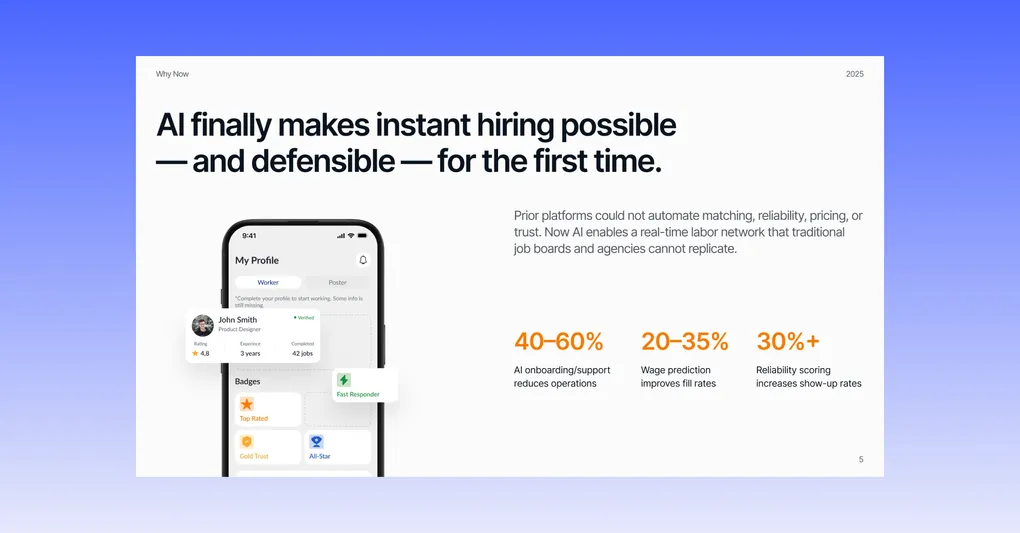
Many founders skip this slide, leaving investors to work out the timing for themselves. Investors are not only asking whether the idea is good. They also want to know why this is the right moment for it to become a company.
Your answer should point to something that changed. Maybe regulation shifted, AI made a workflow possible that was impossible two years ago, customer behavior changed, infrastructure matured, budgets moved, or an old market is being forced to adopt new tools.
The “why now” slide explains the timing. Without it, even a strong idea can feel as though it should have been built years ago. The best version connects an external change to your specific opportunity. It does not just say “AI is growing” or “the market is digitalizing.” It explains why that shift creates a new opening for this exact company.
What goes wrong: The deck assumes the opportunity is obvious. Investors need to see what changed in the world that makes this company possible now.
Slide 5: Market
The market slide should prove that the opportunity can become venture-scale, not display the biggest number you can find. The classic weak version is: “The market is $500B. If we capture 1%, we become a $5B company.” Investors have seen this hundreds of times. It does not show how the business will grow, who buys, what they pay, how reachable the first segment is, or why this company can win.
A stronger market slide starts with the customer.
- Who is the first buyer?
- How many of them exist?
- What do they spend today?
- What segment do you win first?
- How does that expand over time?
This is what a bottom-up market view means: instead of starting with a huge industry number and assuming you will capture a percentage of it, you build the market from the customers you can realistically sell to.
For example, start with the number of target customers in your first segment, multiply it by realistic annual revenue per customer, and then show how the opportunity expands into additional segments, products, or geographies.
The goal is to prove two things: the first market is reachable, and there is a credible path from that initial segment to a venture-scale opportunity.
What goes wrong: The market slide is too top-down. A big TAM without a credible path to capture it does not create confidence.
Slide 6: Traction
Traction moves the deck from belief to evidence. It answers the question investors are always asking: has the world started to vote for this?
The type of traction depends on the stage. At pre-seed, it might include customer interviews, pilots, letters of intent, waitlists, prototype usage, advisor credibility, or early design partners. At seed, investors usually expect stronger signals such as revenue, active users, retention, paid pilots, conversion, or repeatable customer demand. By Series A, the bar is much higher, with more weight placed on growth, retention, sales efficiency, revenue quality, and market pull.
The strongest traction slides do not only show where the company is today. They show how quickly it is moving.
“$100K ARR” is a snapshot. It does not tell an investor whether revenue has been flat for a year or has tripled in six months. Whenever you have enough data, show the trajectory: revenue growth, customer growth, active users, retention, transaction volume, or another core metric that demonstrates momentum.
A clear growth curve is often more useful than several impressive-looking absolute numbers because investors want to understand not only whether traction exists, but whether it is accelerating.
What goes wrong: Founders show a snapshot instead of a trajectory, or present interest as traction. Investors want to understand what is growing, how quickly it is growing, and what customers have actually done rather than what they say they might do.
Slide 7: Business Model
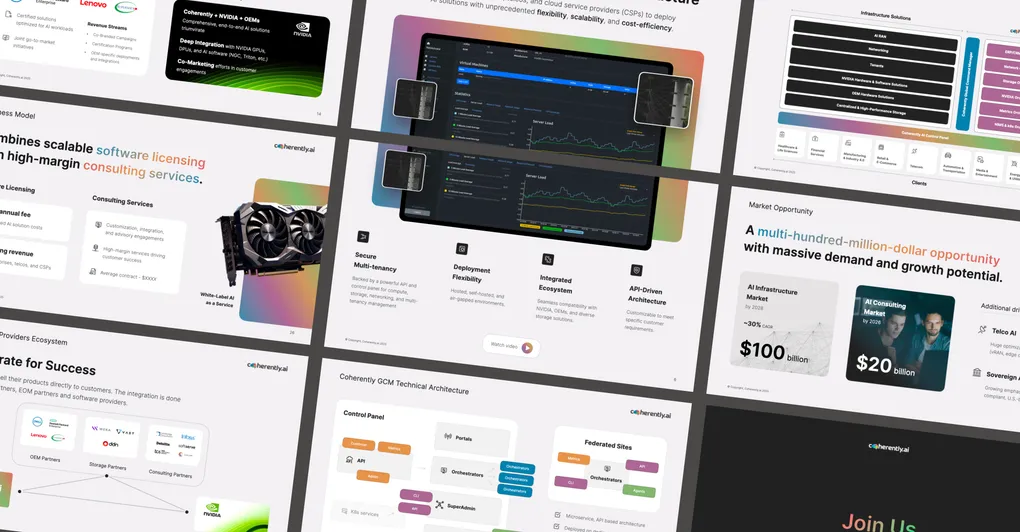
The business model slide should explain how the company turns customer value into revenue and how that revenue can grow over time.
It should answer a few practical questions:
- Who pays?
- What are the main revenue streams?
- What triggers a payment?
- Is revenue recurring, transactional, usage-based, or something else?
- What expands over time?
- What makes the economics attractive?
This slide does not need to become a full financial model. In fact, too much complexity can hurt you, especially at early stages. Pricing can be part of the slide, but pricing is not the business model. A company may change its prices several times while the underlying revenue model stays the same.
The investor should understand where revenue comes from today and how it can expand over time. A SaaS company might start with subscription revenue and later add payments or usage-based fees. A marketplace might earn a percentage of every transaction. An enterprise product might combine an annual platform fee with expansion based on seats or usage.
The exact price may change. The important part is making the revenue engine easy to understand.
What goes wrong: The slide shows only pricing plans - for example, Basic, Pro, and Enterprise - without explaining the actual revenue model. Pricing can change; investors need to understand how the company makes money and how that revenue can grow.
Slide 8: Go-to-Market
A large market and a strong product are not enough if the company has no credible way to reach customers. The go-to-market slide should explain how the business plans to acquire its first customers and turn that motion into repeatable growth.
A strong GTM slide answers questions such as:
- Who is the first target customer?
- How do you reach them?
- Who makes the buying decision?
- What does the sales or acquisition process look like?
- Which channels are working or being tested?
- How can this motion scale?
The goal is not to list every possible marketing channel. “Outbound, content, partnerships, paid ads” is not a strategy by itself. The investor should understand the specific path from target customer to revenue.
For example, a company might begin with founder-led sales into a narrow customer segment, use paid pilots to prove demand, expand within those accounts, and only then build a repeatable sales team.
If you already have data, show it: acquisition cost, conversion rates, sales cycle, pipeline growth, channel performance, or where existing customers came from. At an earlier stage, GTM can still be a hypothesis, but it should be a specific and testable one.
What goes wrong: The GTM slide becomes a list of marketing channels instead of explaining a credible customer acquisition engine.
Slide 9: Team
The team slide should explain founder-market fit rather than repeat everyone’s résumé. Investors want to know why this team is unusually qualified to solve this problem now. Previous employers, universities, and logos can help, but they are not the story by themselves.
A strong team slide connects the people to the opportunity. The founder may have spent ten years in the industry, the technical lead may have built similar infrastructure before, or the team may have a distribution advantage. Perhaps they have lived the problem personally or bring together a rare mix of technical depth and commercial access. Make that connection explicit instead of asking investors to infer why each person matters.
What goes wrong: The team slide lists impressive names without explaining relevance. “Ex-Google” is not a strategy. “Built ML infrastructure at Google, now applying that experience to X” is much stronger.
Slide 10: Ask
The ask slide should connect the amount you are raising to a plan for reducing risk. A weak version says only, “We are raising $1.5M.” A stronger one explains the plan: “We are raising $1.5M to launch the MVP, convert 10 pilot customers, validate pricing, and reach $25K MRR within 12 months.” Now the investor can see what the money unlocks.
The ask slide should usually include:
- Round size
- Use of funds
- Runway
- Key milestones
- Optional: current commitments or lead investor status
The milestones should show how this round gets the company to the next stage of fundability. Investors are not only deciding whether they like the company today. They are deciding whether this round gives it a credible path to becoming more valuable by the next round.
What goes wrong: The ask is vague. If the money does not connect to milestones, the round feels like a budget request instead of an investment plan.
Do you always need exactly 10 slides?
A 10-slide pitch deck is a useful baseline, not a rule. Some companies need eight slides, while others need 14 or a separate technical appendix. A competitive landscape slide may need to appear early, GTM may come before the business model, or traction may precede the market when it is the company’s strongest proof point.
The best structure gives investors the full argument without unnecessary friction and answers their questions in roughly the order they are likely to ask them.
The slides are not the strategy
Founders often assume their deck is weak because a slide is missing. Usually, the issue runs deeper: the problem is unclear, the market is too broad, the solution is overloaded with features, or the “why now” is missing. In other cases, traction is not framed as evidence, the team slide does not establish founder-market fit, or the ask is disconnected from the milestones.
Adding more slides will not fix any of these issues. A strong deck stays focused on what the investor needs to believe and builds that case one slide at a time. The 10-slide structure helps you order that case; it cannot make the case for you.
What to check before you send your deck
Before sending your pitch deck to investors, read only the slide headlines from beginning to end.
- Do they tell a coherent story?
- Can someone understand the company without reading every paragraph?
- Does each slide answer a question created by the slide before it?
- Does the deck build toward the ask?
- Does it make the company feel more fundable by the end than it did at the beginning?
A pitch deck does not need to answer every diligence question. It needs to make the company clear and credible enough to earn the next conversation. That happens when the slides work together as one argument, not when each one is polished in isolation.
If you want to understand what your deck is missing before investors see it, book a free intro call with 100PitchDecks.
We’ll help you see where the story, structure, and positioning can be sharpened.
Artem Pochepetsky is the founder of 100PitchDecks. He has worked on 400+ pitch decks across pre-seed through Series B, with founders across 30+ countries raising a combined $250M+.