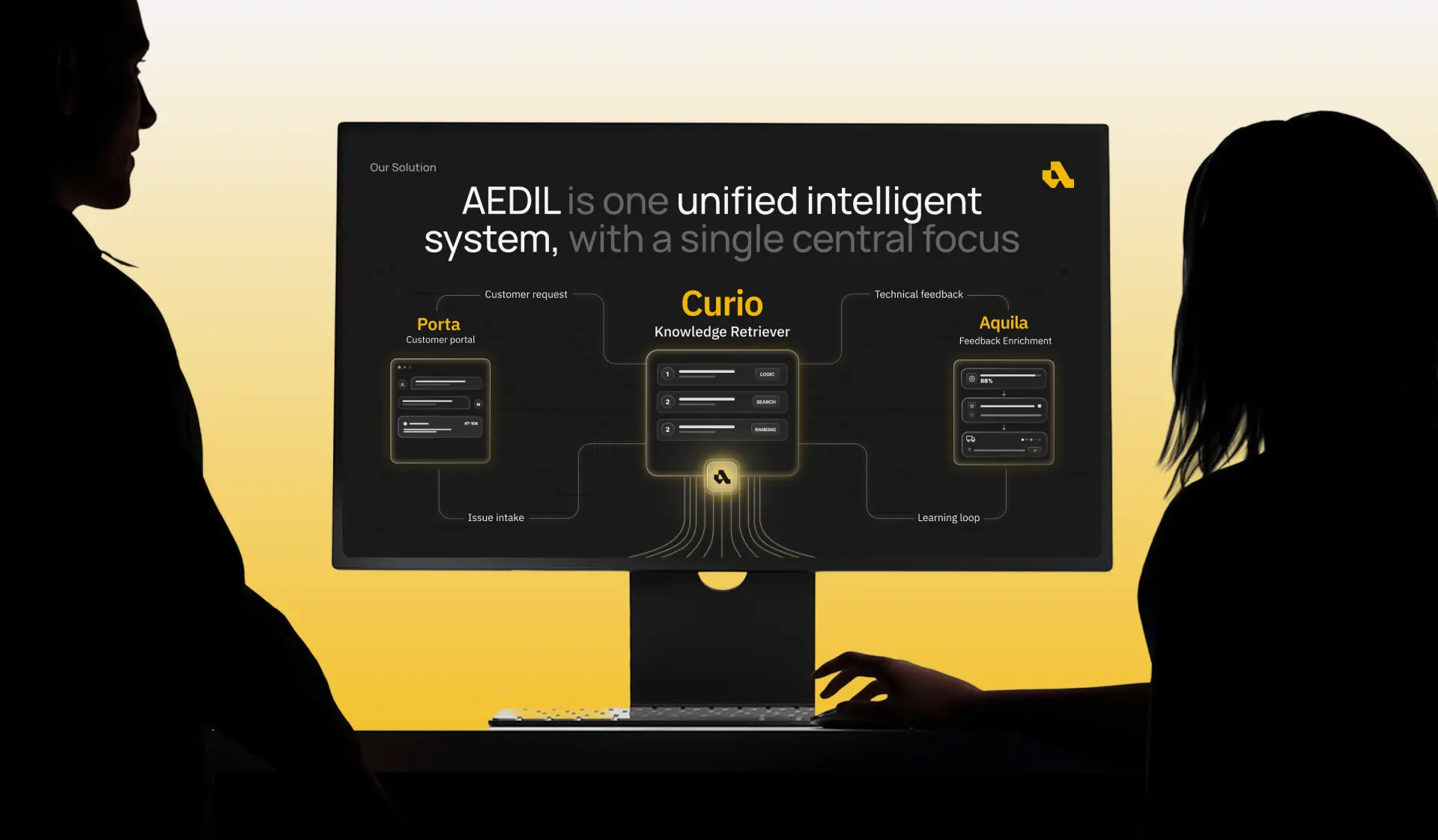
The average investor spends about two minutes on a pitch deck before deciding whether to keep reading or move on. Some studies put it closer to three. Either way, you're not getting a long runway, just a first impression.
After reviewing and building over 400 pitch decks (that have collectively raised more than $250M, many of them for companies that went through YC and Techstars) I've watched this pattern repeat enough times that it no longer surprises me. The best founders understand what investors are actually looking for when they open a pitch deck.
But what do investors look for in a pitch deck?
This article is about that. We're not going to talk about which slides to include, but what's running through investors' heads as they read.
Read on.
How investors actually read a deck
Tell me if this sounds familiar: you open with the problem, walk through the market size, introduce the solution, show the traction, present the team, close with the ask. Slide by slide, logical and sequential. Each section earns the next one. By the end, the evidence has accumulated and the conclusion feels inevitable.
That's how most founders build a pitch deck. It's also not how investors read them.
The most useful pitch deck tips for founders aren't about slide count or design or some cool tricks you can apply. They're about what's running through an investor's head when they go through the deck.
Here's the thing: Investors open a deck looking for reasons to say no. That might sound harsh, but it is important to know. They see dozens of decks a week.
Their job isn't to nurture every opportunity, but to filter down to the ones worth spending real time on. So they skim, jump, look for the one slide that doesn't add up, the claim that seems too convenient, or, the team page that raises questions.
You have roughly two to three minutes to create enough interest that they want to know more. That's it! And the clock starts on slide one.
The 7 things investors actually evaluate

1. A hook that earns the next slide
Investors decide whether they're interested within the first thirty seconds. If slide one doesn't create some form of intrigue, don't expect the rest of the deck to get a fair reading.
The hook is not your logo or tagline (unless your tagline is genuinely sharp). The hook is the moment an investor thinks: I want to see where this goes.
That can come from a striking statistic, a counterintuitive claim, a problem framed in a way they haven't quite heard before. It doesn't need to be dramatic, though. It just needs to make the next slide feel necessary, and motivate investors to get to it.
The founders who get this right usually spend a disproportionate amount of time on slide one. They tend to treat it like merely a cover page, something to move past quickly to get to the real content.
What goes wrong: A company name and a tagline that is vague. "AI-powered solutions for tomorrow's challenges." Nobody would get that, but investors move on without ever knowing what you actually do.
2. A problem they can feel
Investors have heard a lot of problem slides. The format is almost always the same: here's a market, here's inefficiency, here are the numbers.
The problem with that approach is that investment decisions, even at the institutional level, are partly emotional. An investor who doesn't feel the pain of the problem you're solving has no visceral reason to care about your solution. They'll evaluate it intellectually, which means they'll be looking for reasons to doubt it.
The best problem slides do something simple: they make the problem real. A specific story, a concrete moment of failure, a customer quote that shows the frustration. All you need is a strategic storytelling approach.
You're not trying to manipulate anyone. You're trying to transfer understanding and to take something you know deeply and help an investor feel it in a few sentences.
This is harder than it sounds, especially for technical founders who are more comfortable with data than narrative. Good news: it's learnable, and it makes a visible difference.
What goes wrong: "Market research shows 40% of companies have inefficient processes." That's a fact, but no one feels a fact. You need more than raw data.
"Investors don't read pitch decks — they scan them.
You have 10 seconds to make them want to keep going."
— Artem Pochepetsky, 100PitchDecks
3. A solution that's genuinely different
Investors see a lot of "faster and cheaper" solutions. That framing raises an immediate question: faster and cheaper than what, and why hasn't someone already built it?
What makes a good pitch deck is a differentiation in approach: why you're solving the problem in this particular way, what insight makes your method superior, why the obvious alternative doesn't work as well as it might seem. That's the thing investors are listening for.
The cleanest version of this is a slide that answers: "The existing solutions fail because they assume X. We realized that X is wrong, which is why we built something based on Y instead." That's a genuine insight. It implies defensibility and suggests the founders understand the problem at a level that competitors haven't reached.
Founders sometimes hold back here because they're worried about giving away their strategy. That's understandable but… counterproductive. Investors can't get excited about something they can't see clearly.
What goes wrong: "We do X faster and cheaper." That's a product positioning statement, but that doesn't make anyone want to invest. Features can be copied, and that happens all the time. But a true insight is harder to replicate.
4. Numbers that survive scrutiny
The market size slide is the most frequently eye-rolled slide in venture. Not because TAM doesn't matter — it does — but because most founders present it in a way that suggests they've never thought about it seriously.
"The global market is $400B. We're targeting just 1% of that." Every investor has seen this. It says nothing about how you're actually going to build revenue. It doesn't tell them who's buying, what they're paying, why you'll win that segment, or how you scale from zero to meaningful traction.What works is bottom-up thinking: here's how many customers we can realistically reach in our first market, here's what they pay, here's what that means for our Year 1 and Year 3 revenue. That's a model, not an aspiration. It can be questioned, refined, pushed on — and that's good. That's a conversation investors want to have.
Unit economics matter here too. LTV and CAC don't need to be perfect, but they need to be thoughtful. An investor who pokes at your numbers and finds they hold up is an investor who's starting to trust you.
What goes wrong: Top-down market sizing with no explanation of how you actually capture it. The "$500B market, we need 1%" math is a signal that the founder hasn't thought carefully enough about go-to-market.
5. Evidence that real people want this
Traction is the section where the gap between what founders say and what investors hear is widest.
Founders write: "We've spoken to 20 potential customers who are excited about the product." Investors read: "We haven't sold anything yet." The word "interested" does almost nothing in a pitch deck. Interest doesn't validate a business model, that's what money does. Also, commitment, signed contracts, even pilot agreements, even a waitlist with deposits, those are evidence. A list of conversations is just a list of conversations.
This doesn't mean early-stage companies can't raise without revenue. They do it all the time. But the evidence standard shifts anyway.
If you don't have paying customers, you need something else: a letter of intent from a credible company, pilot results with measurable outcomes, a cohort of users with strong retention data, a waitlist that demonstrates genuine demand.
The underlying question investors are asking is: has the world voted on this yet? They want to know before they vote with their own capital.
What goes wrong: "We've spoken to 20 potential customers who are interested." Every investor translates that immediately. Show what customers have actually done, not what they've said they might do.
6. A team that was built for this problem
Of all the pitch deck elements investors care about, the problem and team slides carry the most weight at the seed stage.
The team slide is not a résumé. Investors aren't looking for impressive CVs. After all, they can always just read LinkedIn. What they're evaluating is something harder to put on paper: whether this particular group of people is the right team for this particular problem.
Founder-market fit is the concept. It means you have some unfair advantage in your domain, which can be a decade of industry experience, a technical background that makes your approach possible, a personal connection to the problem that means you'll keep going when it gets hard. It means your team covers the things the business actually needs at this stage: typically product, technical depth, and the ability to sell.
The best team slides don't list everyone's universities. They answer the question: why us, for this problem, right now? A founding team with a combined 20 years in the industry you're disrupting is a different story than three smart generalists who got interested in the space last year. Both can raise, but they need to be positioned differently.
What goes wrong: Roles and university names without context. A Stanford MBA and a Google engineer is a combination that appears on thousands of decks. What makes yours different is the specific reason that combination is right for this problem.
7. A vision worth believing in
Way too many founders undersell this. They put together a conservative three-year projection and present it as a vision. That's a financial model, sure, but it is not a reason to believe in a company.Investors at the early stage are not funding what you are today, but what you could become. The vision slide is where you show them that future with enough ambition that the investor can see why, if it works, this becomes genuinely large and important.
This is also where founders sometimes confuse humility with caution. Saying "we could be doing $20M ARR in four years" is not bold. It doesn't make an investor feel like they're getting in on something. The vision isn't about a safe forecast. It's about the version of this company that changes something — an industry, a behavior, a market structure.
That vision needs to be coherent. It needs to follow logically from everything else in the deck. But it should also be ambitious enough that, when you say it, the investor feels the scale of what's possible.
What goes wrong: A modest, safe projection dressed up as a vision. That's a plan. Investors fund visions. The two are not the same.
What investors notice before slide 1?

The answer to this question almost never appears in pitch deck guides, which is exactly why it matters.
Investors form an impression of your company before they read a single word. The quality of the document itself is a signal. It is about your attention to detail, your aesthetic judgment, and whether you take this seriously.
A deck with inconsistent fonts, off-brand colors, crowded slides, or low-resolution images communicates something before any content is absorbed.
It says: we built this fast, we didn't have anyone check it, the standard of work here is approximate. That's not a fatal signal on its own, but it's a headwind. You're starting from a slightly lower position. Alas.
A well-designed deck communicates something completely opposite. It says you think carefully about how things look, you have taste, you care about how you present your company.
Investors are going to be betting on you to build a team, attract customers, and develop a brand. The way you present yourself in a deck is actually evidence of how you'll do all of those things.
Design quality is a credibility proxy. It's not the main event, but it's a real factor, and it shouldn't be treated as an afterthought.
Most common reasons investors pass
Let's take a look at the question from a different perspective. What actually causes the tab to close?
The problem doesn't feel real. The deck describes inefficiency in the abstract. No investor connects with it.
The market isn't big enough. This is sometimes a real constraint, sometimes a framing problem. A small market is a small exit. Investors need to see a path to something meaningful.
The "why now" is missing. Investors are always asking: why is this the right moment to build this? Regulatory change, infrastructure shift, behavior change, something needs to have changed recently that makes the timing make sense. Without this, even a good idea reads as "should have done this five years ago."
The founding team doesn't inspire confidence. This is often felt rather than explained. Something about the way the team is presented, or the questions it raises, makes an investor uncertain about execution.
The numbers don't hold. One flimsy statistic is enough to put an investor in skeptic mode for the rest of the deck. Once doubt is present, everything else gets scrutinized more harshly.
The ask is unclear or off. A round size that doesn't match the stage, or vague language about use of funds, signals that the founder hasn't thought carefully about the raise.
What's changed in 2026
The fundraising market in 2026 looks meaningfully different from two years ago, and that changes what investors are actually looking for when they open a deck.
AI has flooded the deck pipeline. The result is that "AI-powered" has become the new "blockchain-enabled". That is a phrase that once signaled innovation, but now triggers skepticism.
Investors are more likely to push back on AI claims, ask how the model is trained, and want to understand why your approach actually works rather than accepting the label.
Proof is worth more than it was two years ago. The easy money phase of 2020–2021 is over. Investors across stages are more cautious, more metrics-driven, and more focused on fundamentals. Early traction (even small revenue, even a strong pilot) carries more weight in 2026 than it did when the market was more forgiving.
The other change is speed. Investors are still moving, but they're being more deliberate. A deck that can't quickly and clearly convey why this team, this problem, this moment, loses the deal in the first read. There's less patience for ambiguity than there was a few years ago.
The deck is a door, not a decision
No investor writes a check based on a pitch deck alone. What the deck does is open a door. It earns the first call, which leads to the second, which leads to due diligence, which leads (sometimes) to a term sheet.
The deck's job is to make an investor want to keep going. Everything in it is in service of that single goal: move to the next step.
If you want a set of eyes on your deck from someone who's been through this process over 400 times, book a free intro call and let's talk
Artem Pochepetsky is the founder of 100PitchDecks. He has worked on pitch decks for founders across DeepTech, FinTech, AgTech, and SaaS, including YC and Techstars alumni, with clients collectively raising over $250M.