Search for pitch deck examples and you will find the same names almost immediately.
Airbnb. Uber. Buffer. Dropbox. Maybe LinkedIn.
They are useful decks to study. But there is a problem with treating them as templates: most founders end up looking at what those decks looked like, rather than understanding why they worked for those particular companies at that particular moment.
A strong investor pitch deck is not strong because it uses the right shade of blue, keeps every slide under 30 words, or follows a famous 10-slide structure perfectly.
It works because it makes the business easier to understand, easier to believe, and easier to remember.
After working on 400+ pitch decks for founders across different industries and funding stages, we have seen this distinction repeatedly. Strong decks can look completely different from one another. A consumer brand, a DeepTech company, a fintech startup, and a Series A SaaS business should not have identical presentations.
What the best pitch deck examples share is not a visual template. It is the way they direct attention.
So instead of giving you another gallery of famous startup pitch decks to copy, let's look at what strong investor decks actually do differently - and what founders can learn from them.
What should you actually learn from pitch deck examples?
A pitch deck example is most useful when you stop asking:
"How can I make my deck look like this?"
And start asking:
"What is this slide making the investor understand or believe?"
That shift matters.
A beautiful traction slide might be effective because it turns six months of growth into one obvious pattern. A technical diagram might work because it removes complexity rather than displaying expertise. A simple team slide might be powerful because the founders' experience is directly connected to the problem they are solving.
The visual execution matters, but the reasoning underneath it matters more.
When we evaluate investor pitch deck examples, we usually look at three layers at once: the investment story, the evidence supporting it, and the visual hierarchy that determines what gets noticed first.
If one of those layers is weak, the deck usually feels weaker than the business behind it.
1. Strong pitch decks make the company understandable before making it impressive
Founders naturally want to lead with what is impressive.
The technology is proprietary. The market is enormous. The founding team has worked at recognizable companies. There are seven product modules. The platform is powered by AI. The company can eventually serve six industries.
All of that might be true. But if an investor does not yet understand what the company actually does, none of it has much value. This is one of the clearest differences between weak and strong pitch deck examples.
Strong decks establish orientation early.
An investor should quickly understand what kind of company they are looking at, who the customer is, what important problem exists, and roughly how the company changes that situation. Only then should the deck ask them to appreciate the sophistication behind it.
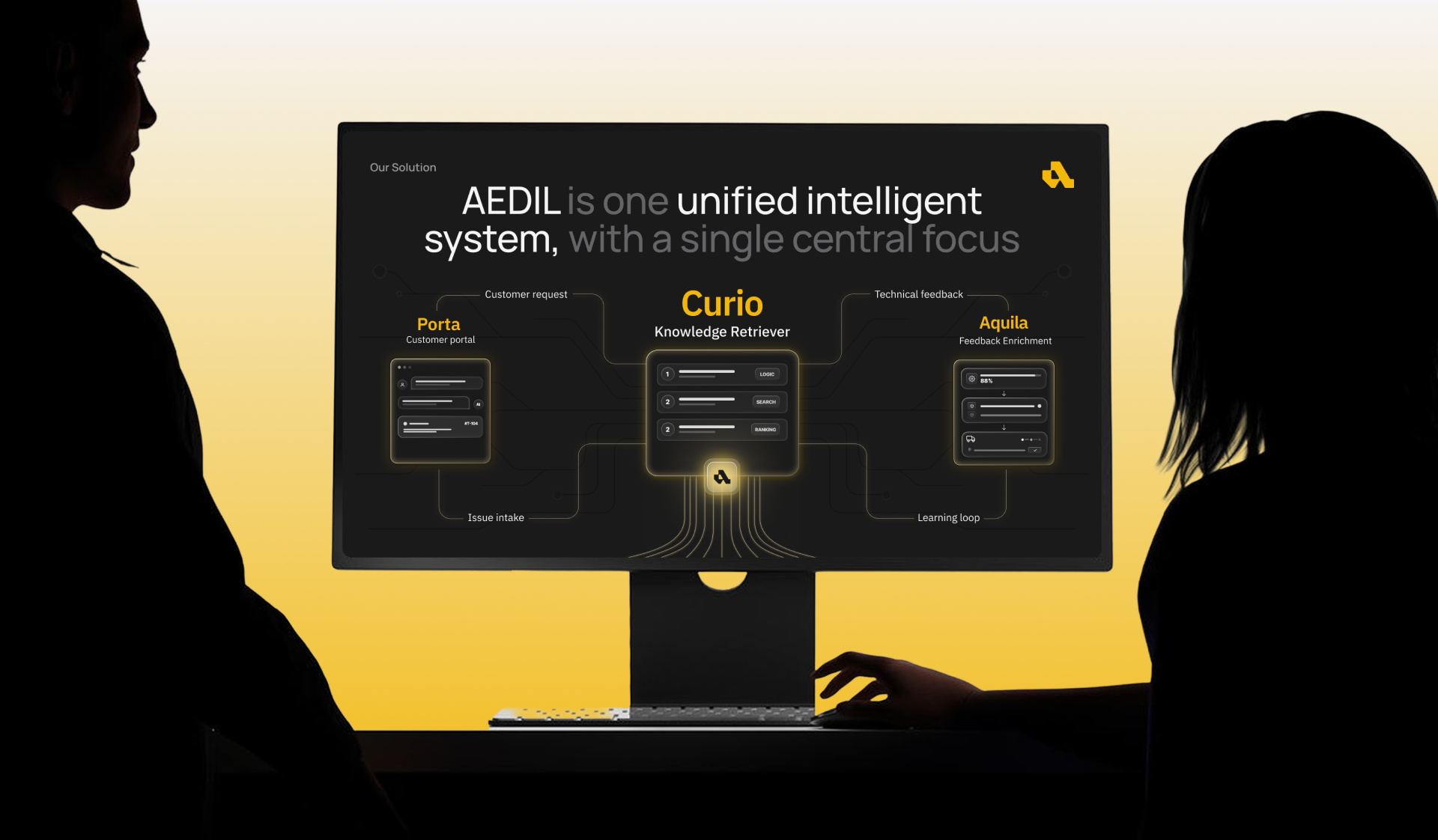
We saw this clearly while working on Coherently.ai, an AI infrastructure company dealing with technically complex concepts such as orchestration, APIs, infrastructure management, and multi-tenant deployments. Trying to communicate all of that at once would have made the company feel more complicated, not more advanced.
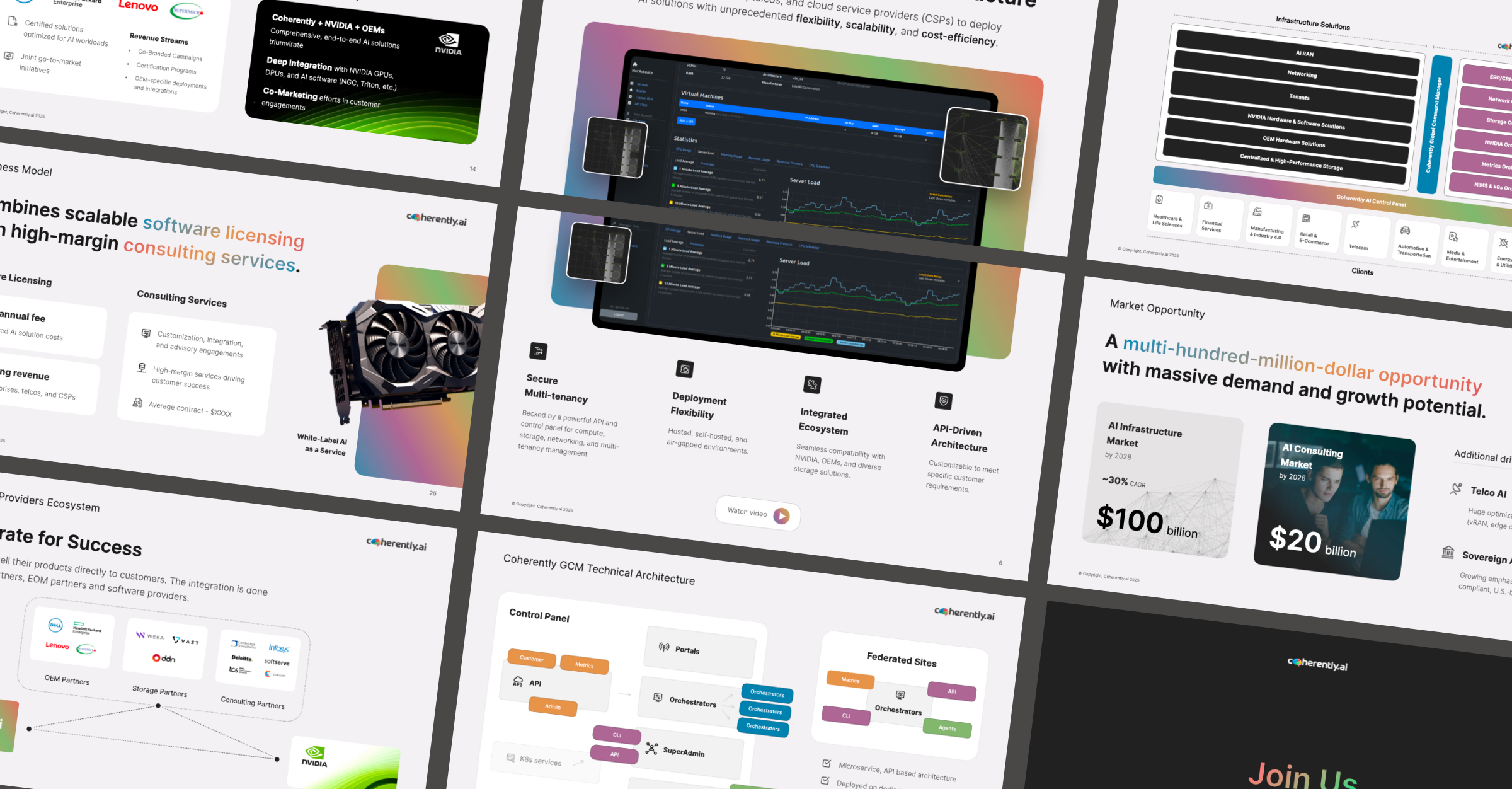
Instead, the story was structured so the investor could move from the business problem into the product architecture gradually. Complex workflows were translated into modular diagrams, and the company's origin story - including the fact that the product opportunity emerged from a request by NVIDIA - became part of the investment narrative rather than another isolated credibility logo.
That is an important distinction.
Complexity can demonstrate depth once understanding already exists. Before that, it is friction.
The best pitch deck design does not show investors how much information you have. It decides how much information they need right now.
2. The best investor decks are built around the company's strongest proof
There is a reason blindly copying famous startup pitch deck examples rarely works. Different companies have different reasons to believe.
A pre-seed founder might have extraordinary founder-market fit but almost no revenue.
A Seed company might have a small number of customers but exceptional retention.
A Series A company may already have enough operating data that the growth curve should appear before a lengthy explanation of the market.
A DeepTech startup might have limited commercial traction but extraordinary technical validation.
The strongest decks recognize this and build around the evidence the company has actually earned.
Take Mottiv, for example. The company was preparing for Series A conversations with an existing product, an engaged community, traction, and a founder who was already deeply embedded in the endurance sports market.
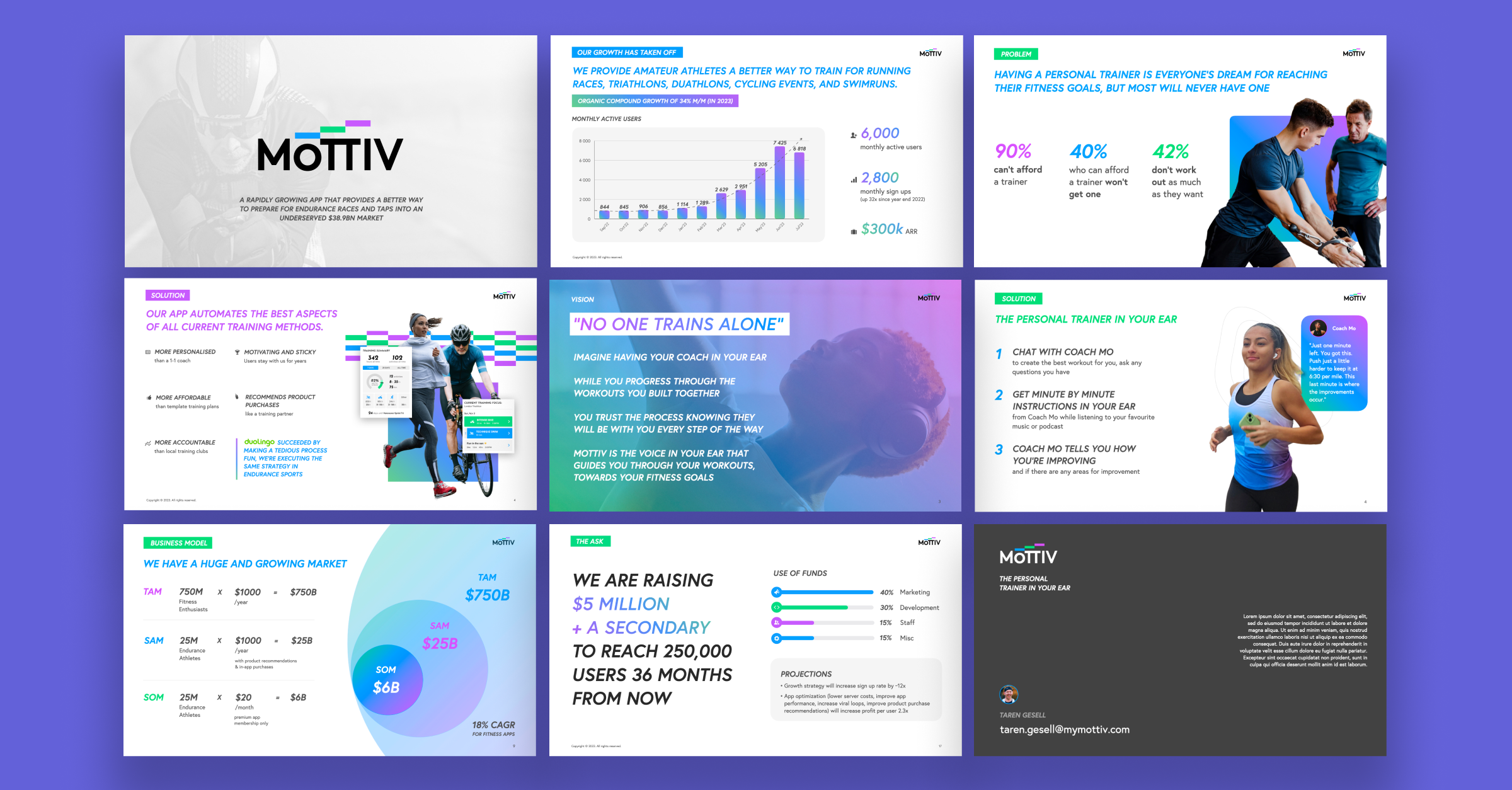
The founder's background was not treated as a biography section near the end of the presentation. It was part of the company's competitive logic. His experience as an endurance athlete and major creator in the category helped explain customer understanding, distribution, credibility, and founder-market fit. At the same time, metrics around users, retention, revenue, unit economics, and margins were given enough visual weight to make the business feel measurable rather than personality-driven.
For Mottiv, that combination of founder-market fit and strong operating metrics became a key part of the investment story. But another company might need to build its case around entirely different proof. That is why the better question is not "Where does the traction slide normally go?" but how important traction is to the investment case for this company at this stage.
Your strongest evidence should appear where it adds the most credibility, not where a standard template says it belongs.
3. Strong pitch deck examples interpret numbers instead of displaying them
A common fundraising deck mistake is assuming that a metric becomes persuasive as soon as it appears in large typography.
$120K ARR.
84% retention.
37 enterprise customers.
220% YoY growth.
€18B TAM.
Those numbers might be excellent. But investors still need to understand what they mean.
A good traction slide does not simply report the current state of the company. It helps the investor interpret momentum.
A growth curve can be more powerful than a single revenue number because it answers a second question automatically: where is this going?
The same logic applies to financial slides.
When we worked on the investor deck for Bite Me, a European healthy snack company, the goal was not to make metrics such as margins, cost of goods, marketing efficiency, and financial forecasts look decorative. The goal was to make them fast to evaluate.
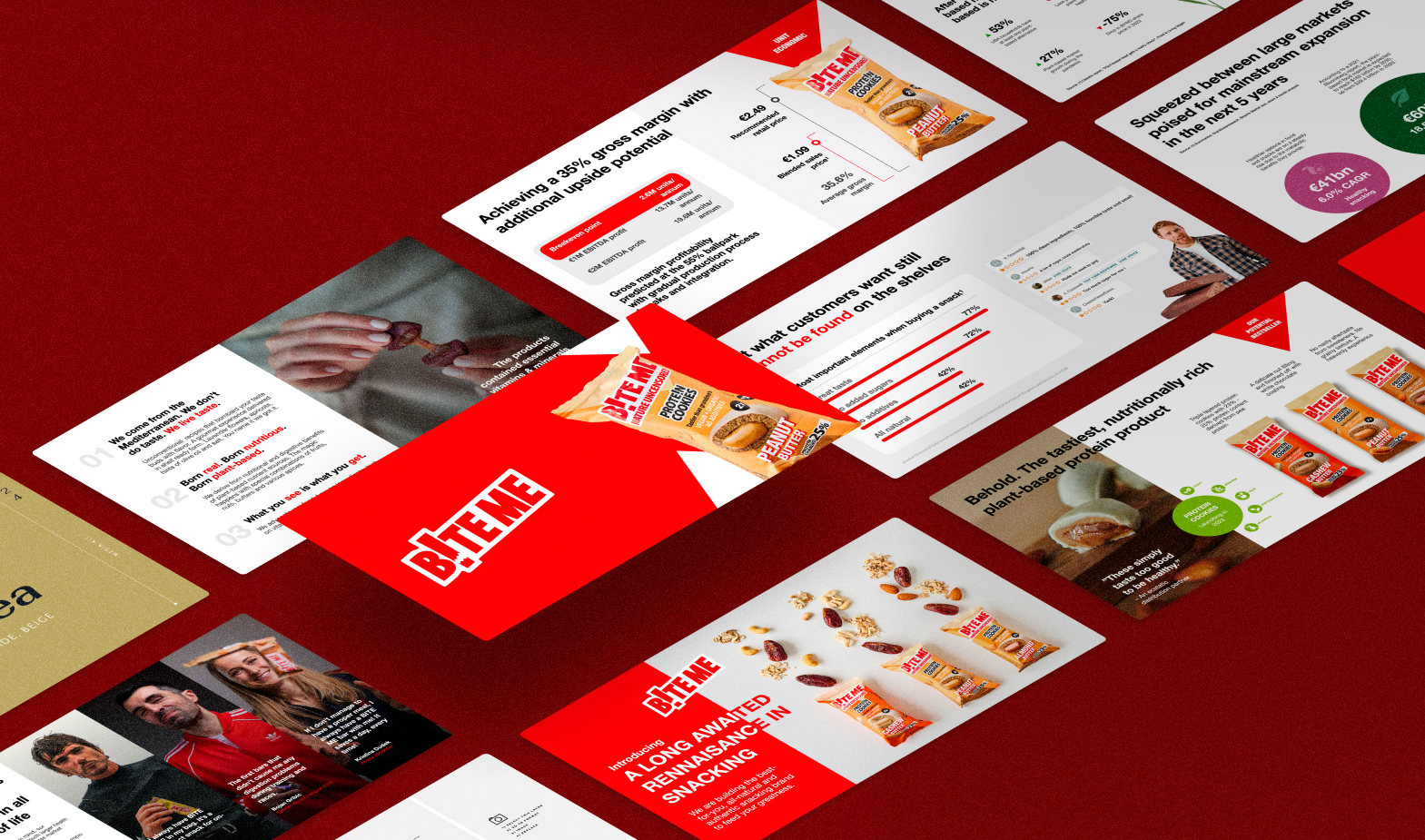
Instead of turning the financial section into a dense spreadsheet inside PowerPoint, the information was grouped and prioritized so investors could understand the company's economics without fighting through the slide.
That is what good pitch deck design does with data. It does not remove detail indiscriminately. It creates hierarchy. The investor should know what number matters, why it matters, what changed, and what conclusion you want them to reach.
If you show 14 KPIs with identical visual weight, you are not giving the investor more information. You are outsourcing prioritization to them.
4. Strong decks turn product complexity into a simple mental model
This is especially important for SaaS, AI, fintech, healthcare, DeepTech, and infrastructure companies, where the product can be genuinely complex.
Founders often know the product almost too well. They have spent months or years thinking about architecture, integrations, workflows, features, edge cases, infrastructure, and roadmap decisions. When it is time to build the fundraising deck, the instinct is often to compress all of that knowledge into a few product slides. The result can easily start to feel more like technical documentation than an investor presentation.
Investors need enough detail to believe that the product is real, differentiated, and difficult to replicate. But they should not need to become product experts before they can understand why the opportunity matters.
A strong product section gives them a clear mental model. That might mean showing a simple three-step workflow, comparing what happens before and after the product is introduced, simplifying the architecture into the few layers that actually matter to the investment case, or using one annotated product screenshot instead of several competing for attention.
Good simplification is not the same as removing substance. It is about deciding which details help the investor understand the business and which can wait for a deeper conversation.
That is why some of the strongest technical pitch deck examples feel surprisingly simple. The complexity still exists - it has just been organized so the investor does not have to untangle it.
5. Great pitch deck design makes the company feel like the company it wants to become
Design is not the investment case, but it has a real influence on how that case is perceived. Before an investor starts questioning the financial model, market assumptions, or growth strategy, they are already forming an impression from the presentation itself.
A strong deck should feel intentional and appropriate for the business it represents. The visual language can signal whether the team understands its customer, whether the company feels credible within its category, and whether the level of execution matches the ambition of the story being told.
There is no single visual style that works for every startup.
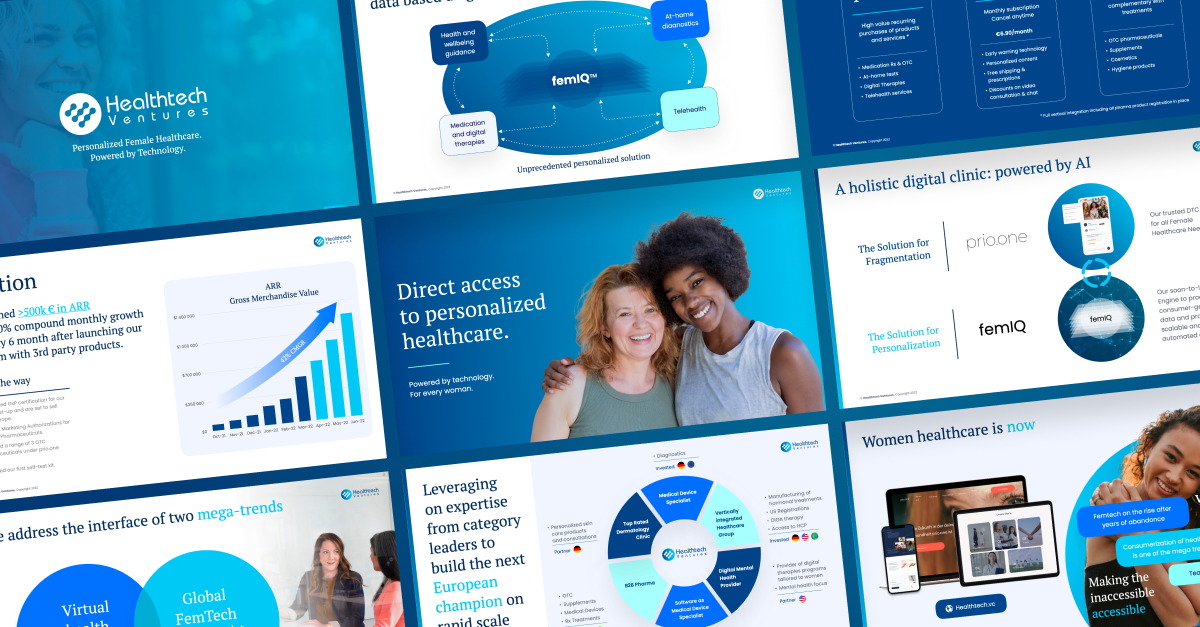
For Healthtech Ventures, the challenge was balancing the emotional side of women's healthcare with the credibility expected from an AI and medical technology business. A presentation that felt purely clinical could lose the human side of the company. One that leaned too far into soft consumer branding could weaken the perception of technical and medical sophistication. The visual system therefore had to carry both sides of the story - trust, empathy, technology, and scale.
Fintech creates another design problem.
When we worked on Wavee, the deck needed to feel modern and accessible while still communicating the trust and financial discipline expected from a company operating around money. Clean layouts, controlled visual language, and carefully structured financial slides helped make the concept feel like a serious financial platform rather than an early experiment.
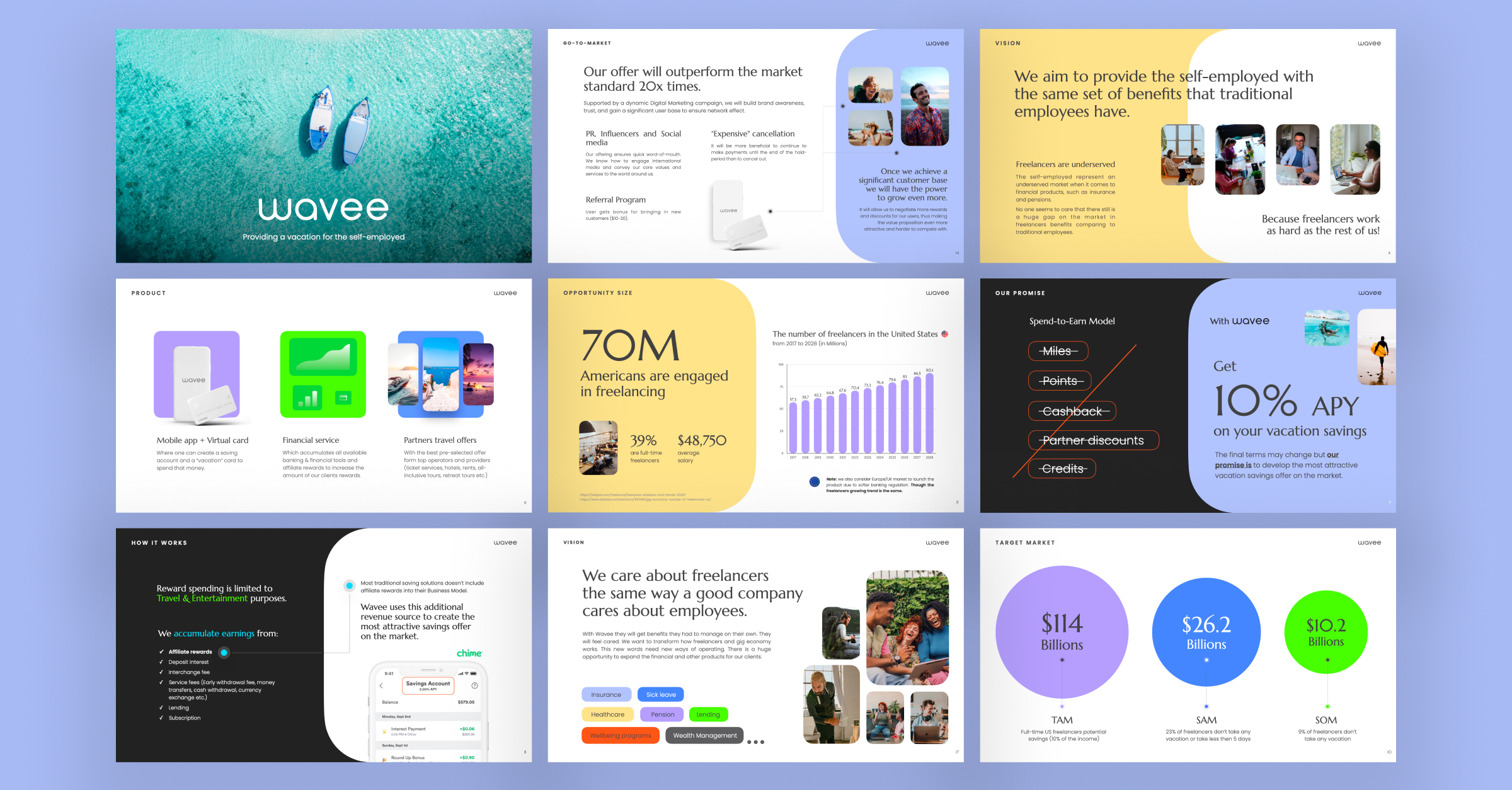
Neither of these decks should look like a playful consumer app. Neither should look like a generic VC template. That is the point. The best pitch deck design examples are not visually successful in isolation. Their design reinforces something the investor needs to believe about the business.
6. Strong decks use headlines to tell the story
One of the fastest ways to tell whether a pitch deck is actually working is to ignore everything except the slide headlines.
If your deck reads like this:
Problem
Solution
Market Opportunity
Our Product
Traction
Business Model
Team
you have labels. You do not yet have a narrative. Those labels tell the investor what type of information is on the slide, but they do nothing to advance the argument.
Compare that with a sequence where the headlines themselves communicate the logic:
Independent clinics lose hours every day because their core systems do not communicate
Existing platforms were built for hospital networks, not smaller practices
We automate the administrative handoffs where clinics lose the most time and revenue
Early customers are already processing claims 40% faster
Even before reading the supporting copy, the investor can see the shape of the opportunity. This matters because investors do not always read presentations in the patient, linear way founders imagine. They scan, jump between slides, focus on headlines and numbers, and return to sections that create questions. Your existing investor guide on 100PitchDecks makes the same point: investors tend to scan rather than carefully consume every line.
Your headlines therefore need to do more than organize the page. They need to carry meaning.
7. Strong pitch decks show evidence at the moment doubt appears
Imagine your deck claims that customers urgently need a new solution. The investor's natural response is: How do you know?
If the supporting evidence appears only several slides later, the investor may spend that entire time questioning the assumption. Strong decks anticipate those moments of doubt and support important claims when they appear, rather than asking the investor to remember them until the proof arrives.
That evidence can take different forms. A customer quote can strengthen the problem statement, a pilot result can validate a product claim, a market shift can support the "why now," and a relevant benchmark can make a technical advantage more credible. Customer logos or adoption data can also appear where they reinforce the point being made instead of being saved exclusively for a dedicated traction slide.
This is why evidence should not live only in one section of the deck. It should appear wherever it makes the story more believable.
The difference may seem small, but it changes the rhythm of the entire presentation. Instead of making a series of claims and asking investors to trust you until the proof arrives, you build credibility progressively as the story develops.
A strong pitch deck does not eliminate investor questions. It eliminates the unnecessary ones.
8. Good pitch deck examples create focus by leaving things out
One of the hardest parts of building a strong pitch deck is deciding what not to include. Founders rarely struggle because they have too little to say. More often, the opposite is true: product features, market research, partnerships, competitor analysis, customer quotes, roadmap plans, team experience, and financial projections can all feel equally important.
That is why decks tend to grow. Another slide gets added to explain a feature, then another to cover a market segment, then another because an important customer quote did not fit anywhere else. Eventually, the presentation feels comprehensive - but comprehensive and convincing are not the same thing.
An investor deck is not a due diligence folder. It does not need to contain every fact someone could ever want to know about the company. Its job is to make the opportunity clear, credible, and interesting enough to earn the next conversation.
That requires editing as much as writing. Sometimes the most valuable improvement is not adding another slide, but removing information that competes with the main story. If something is useful for a deeper discussion but not necessary for the first investment decision, it can often move into the appendix. This keeps the core deck focused while still giving the founder enough material to answer detailed questions later.
9. The strongest pitch deck looks different at Pre-Seed, Seed, and Series A
Another reason the "perfect pitch deck template" does not exist is that investors are evaluating different risks at different stages. The basic building blocks may be similar, but the type of evidence that deserves the most attention changes significantly as the company develops.
Pre-Seed pitch deck examples
At pre-seed, investors are often evaluating a thesis before there is much operating data to rely on. The quality of the problem insight, the timing of the opportunity, founder-market fit, early customer validation, and the scale of the potential market can therefore carry more weight than detailed financial performance.
At this stage, a polished five-year forecast cannot replace evidence that the founders deeply understand the problem and have a credible reason to solve it. In fact, too much precision too early can have the opposite effect, making the deck feel more speculative rather than more professional.
Seed pitch deck examples
By Seed, the company usually has more evidence, and the deck should reflect what has actually been learned. Investors will want to understand who is using the product, whether customers are paying and staying, which segments are responding best, and whether there are signs of a repeatable go-to-market motion.
The narrative still needs ambition, but there is less room for unsupported statements. Claims about demand, product value, or market fit should increasingly be backed by customer behavior, revenue, retention, pilots, usage, or other measurable signals.
Series A pitch deck examples
At Series A, the analytical layer becomes much more important. Investors are no longer looking only for evidence that the company can work - they want to understand whether the model has a credible path to scale.
Growth quality, retention, revenue quality, unit economics, sales efficiency, and go-to-market performance usually deserve much more attention. The presentation itself should evolve with that maturity. A Series A deck built mostly around vision statements can feel underdeveloped, while a pre-seed deck overloaded with cohort analysis and detailed long-term assumptions can feel equally out of place.
The strongest pitch deck examples are not simply polished versions of the same template. They present the kind of proof that makes sense for the company's current stage.
How to use pitch deck examples without copying them
If you are reviewing startup pitch deck examples before building your own, it is better to treat them as research rather than templates. Instead of copying the order of the slides or borrowing a visual layout, look at the decisions behind the presentation.
Pay attention to what the investor understands within the first few slides, what the company's strongest proof is, and how early that proof appears. Look at what each chart, screenshot, number, or visual is actually supposed to demonstrate. You can also try reading only the headlines to see whether the investment story still makes sense without the supporting copy.
It is equally useful to notice what the deck chooses not to explain. Strong presentations are often selective, keeping secondary detail in the appendix rather than forcing everything into the main narrative. And when comparing examples, prioritize companies at a similar funding stage or with a similar business model to yours.
The most important principle is simple: borrow the logic, not the layout.
Copying another company's structure can feel safe because that company successfully raised capital. But it did not raise because its traction slide happened to be slide seven. It raised because investors saw enough evidence, at the right moment, to believe in that specific opportunity.
What weak pitch decks do differently
Weak decks often contain all the expected sections, which is exactly why they can be difficult to diagnose. There may be a problem slide, solution, product, market, competition, traction, business model, team, financials, and fundraising ask. Technically, nothing is missing - and yet the presentation still feels flat.
Usually, the issue is that the slides work as separate pieces rather than as one investment argument. The problem does not naturally create a need for the solution. The product is shown without making the differentiation clear. The market looks large, but feels disconnected from the customer the company can realistically reach. Traction becomes a collection of metrics instead of proof that the underlying thesis is working.
The same thing can happen later in the deck. A team may look impressive on paper without explaining why those particular people have an advantage in this market. The fundraising ask may state how much capital is being raised without showing what that capital will actually unlock.
Strong decks make those connections explicit. The investor should not have to assemble the business case on the founder's behalf.
A simple way to evaluate your own investor deck
One useful way to review your pitch deck is to look at it as if you knew absolutely nothing about the company. Move through the presentation quickly rather than carefully reading every sentence, because that is often closer to how an investor will experience it for the first time.
After the opening slides, can you explain the company in one sentence? By the middle of the deck, do you understand why customers need the product and why this particular approach is different? When you reach the traction section, do the numbers meaningfully increase your confidence in the business?
The same test applies to the team and the fundraising ask. Does the team slide make it clear why these founders are unusually well positioned to build the company? By the final slides, does the amount being raised and the planned use of capital feel like the logical next step rather than an isolated request?
If the story becomes unclear at any point, you have probably found an area that needs work. And the solution is not always more information. Very often, it is more focus.
The best pitch deck example is not the one you can copy
There is nothing wrong with studying successful pitch decks. In fact, good examples can teach you a lot about how founders simplify complex businesses, frame markets, visualize traction, explain products, establish credibility, and build momentum across a presentation.
But the most valuable lesson is rarely a particular slide layout.
Effective investor decks are selective. They understand what investors need to believe about that specific company, identify the strongest evidence available, and structure the presentation so those conclusions are easy to reach.
That is why excellent pitch decks can look completely different from one another. One company may lead with traction because rapid growth is its strongest proof, while another needs to establish a major market shift first. One product may require a clear architecture diagram, while another can be explained with a single annotated screenshot. For one company, founder-market fit may be central to the investment case; for another, the team slide can remain relatively simple.
A good pitch deck does not make your company look like a startup that raised money before. It makes your company easier to understand as an investment.
And that is what the best pitch deck examples are actually worth studying.
If you are building or rebuilding an investor deck and are not sure what your strongest story is, book an intro call with 100PitchDecks.
We help founders sharpen the investment narrative, structure the right evidence, and turn complex businesses into pitch decks investors can understand quickly.
Artem Pochepetsky is the founder of 100PitchDecks. He has worked on 400+ pitch decks for founders across multiple industries and funding stages, with clients raising a combined $250M+

.jpg)