At the pre-seed stage, investors are not expecting to see a polished company with years of financial history, predictable growth, and a long list of customers. In many cases, the product is still being tested, the team is working with an MVP, and traction may be limited to a few pilots, early users, or initial customer conversations. That does not mean there is nothing to evaluate. It simply means investors are looking at a different set of signals.
A pre-seed pitch deck is less about proving that the business already works and more about showing why it has a real chance to work at scale. Investors need to understand the problem, the logic behind the solution, the size of the opportunity, and whether the founders appear capable of turning the idea into a company. At this stage, the quality of the story matters more because there are fewer hard numbers to rely on.
If you are still working on the basic slide structure, our guide How to Build a Pitch Deck for a Pre-Seed Round covers that side of the process in more detail. Here, the focus is slightly different: what investors are actually trying to understand when they open an early-stage deck.
1. A Problem Worth Solving
A strong pre-seed pitch usually starts with a problem that feels specific and important. Saying that customers are frustrated, that a process is inefficient, or that an industry is outdated is rarely enough. Investors see statements like these all the time, and without context they do not reveal much about how deeply the founders understand the market.
The problem becomes much more convincing when it can be quantified. If a company loses money because of an inefficient process, show how much. If employees spend too much time on manual work, explain what that time costs the business. In B2B especially, translating a problem into financial impact makes the opportunity easier to understand. A good problem slide should make it clear who experiences the issue, how often it happens, and why solving it is worth paying for.
For example, compare these two versions:
Too vague:
Recruiting teams waste too much time on inefficient hiring processes.
More useful:
Mid-sized tech companies lose dozens of recruiter hours every week to manual candidate screening, increasing hiring costs and slowing down time-to-hire.
The exact numbers need to be supported by real data, but the principle is simple: move from a generic pain point to something an investor can actually evaluate.
This is also one of the first places where founders can demonstrate real expertise. The goal is not to dramatize the problem with generic stock photos or exaggerated language, but to show that the team understands the customer better than someone who has only spent an hour researching the industry.
2. A Solution Investors Can Understand Immediately

A common mistake in early-stage decks is introducing the product through a long list of features. Founders are naturally close to what they are building, so it can feel important to explain every workflow, integration, dashboard, or AI capability. For someone seeing the company for the first time, this often creates more confusion than clarity.
Before going into features, the investor should be able to understand the basic product in one sentence: what it is, who it is for, what it helps them achieve, and what makes the outcome meaningful. Only after this basic picture is clear does it make sense to move into how the product works and what makes the technology different.
A useful starting formula is:
[Product type] for [target customer] that helps them [measurable outcome] through [key differentiation].
For example:
An AI platform for recruiting teams that helps companies identify qualified candidates faster by automating the first stage of candidate screening.
It is not meant to replace the rest of the solution section. It simply gives the investor a clear frame before you start explaining the details.
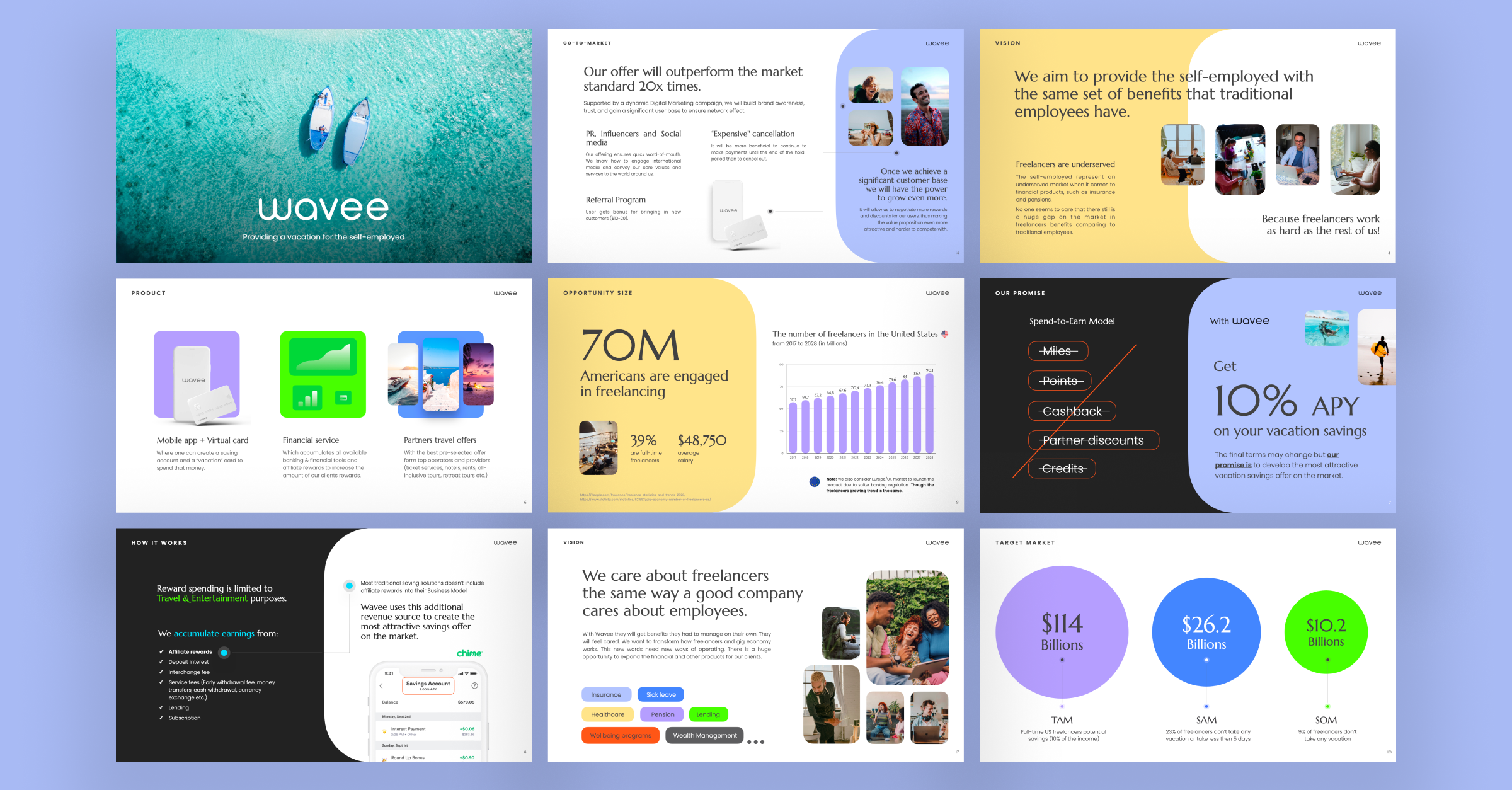
The solution slide is also one of the places where visuals matter most. If the product already exists, show it. Investors should be able to see whether it is a web platform, mobile application, API product, hardware solution, or something else. Even when the technology is complex, giving the investor some kind of visual anchor usually makes the product easier to remember.
3. A Real Point of Innovation
Venture investors are not simply looking for another company that can become profitable. They are looking for businesses that can grow much faster than a traditional company and create a significantly larger outcome. That usually requires some form of innovation.
Innovation does not always mean a scientific breakthrough or a completely new technology. It can come from a different business model, a better distribution mechanism, a new combination of existing technologies, or a more efficient way of solving an existing problem. The important part is that there should be a clear reason why the company is not just another version of something that already exists.
The pitch deck should make that distinction visible without forcing the investor to search for it. If the differentiation can only be understood after ten slides or a long product demo, the story is probably not yet clear enough.
4. A Market Large Enough to Support Venture-Scale Growth
A business can solve a real problem and still be a poor fit for venture capital if the market is too small. Investors need to see a realistic path toward a company that can become large enough to generate venture-scale returns.
Market size alone, however, is not enough. Investors also look at how quickly the market is growing and what is changing within it. Fast-growing markets, shifts in customer behavior, new technologies, or regulatory changes can create much stronger opportunities for new companies.
This is why market sizing should go beyond simply showing TAM, SAM, and SOM. Investors want to understand how those numbers were calculated, which customer segment you are targeting first, how much each customer could realistically spend, and how the opportunity can expand over time.
A strong market slide should answer two questions: How big can this become? and Why is now a good time to build it?
Sources matter too. Large market claims, growth rates, and financial assumptions should be supported by credible data, because inconsistencies can quickly weaken investor confidence.
5. Evidence, Even Without Significant Revenue
Pre-seed companies often do not have meaningful revenue yet, but that does not mean the deck should be built entirely on assumptions. Investors still want to see evidence that the founders are testing the idea and reducing uncertainty.
Depending on how early the company is, that evidence might include:
- an MVP or working prototype;
- early users or design partners;
- paid or unpaid pilots;
- customer interviews;
- waitlist demand;
- initial retention or usage data;
- partnerships or letters of intent;
- results from early experiments.
These signals do not all carry the same weight, and they should not be presented as if they do. A signed pilot is different from a customer interview, and a few positive conversations are not the same as proven demand. The important thing is to be clear about what has actually been validated and what is still being tested.
There is no need to make the startup appear more mature than it is. At pre-seed, investors know that many things are still assumptions. What matters more is whether the founders are systematically turning those assumptions into evidence.
6. A Team That Makes Sense for This Company
At pre-seed, the team often carries more weight than it would in a later-stage pitch because there is less operating history to analyze. Investors are effectively making a bet not only on the current idea, but also on the founders' ability to adapt when assumptions change.
A useful team slide should therefore do more than list job titles, previous employers, and education. It should explain why these people are particularly well suited to build this company. Relevant industry knowledge, technical expertise, previous startup experience, customer access, or a long-term connection to the problem can all matter more than a prestigious logo in a biography.
The strongest version of this slide answers a simple question: why this team, for this problem?
That matters because venture investors are not only investing in an idea as it exists today. They are also evaluating whether the people behind it are capable of taking the company from an early concept to an MVP, product-market fit, and eventually a scalable business.
7. A Story Investors Can Follow
Even when all the right information is present, a pitch deck can still feel weak if the slides do not connect. Investors should not have to assemble the story themselves.
The structure usually follows a natural sequence: there is a meaningful problem, the company has a specific solution, the market is large enough, there is a way to make money, and the team has a credible reason to win. Each section should answer the question created by the previous one.
In practice, the narrative often looks something like this:
Problem → Solution → How It Works → Market → Business Model → Financials → Team
The point is not that every startup has to follow exactly the same template. The point is that the information should arrive in an order that feels natural to someone who knows nothing about the company.
This is where storytelling becomes especially important in early-stage fundraising. It is not about making the deck more dramatic. It is about creating a clear narrative that allows an investor to understand the company quickly, retell the idea to someone else, and remember why it stood out. Clear content comes first, storytelling connects it, and design helps the presentation earn and hold attention.
That same principle is also why we treat pitch deck work as more than slide design at 100PitchDecks. The visual system should support the investment story, not try to compensate for one that is still unclear.
8. A Vision Bigger Than the Company Today
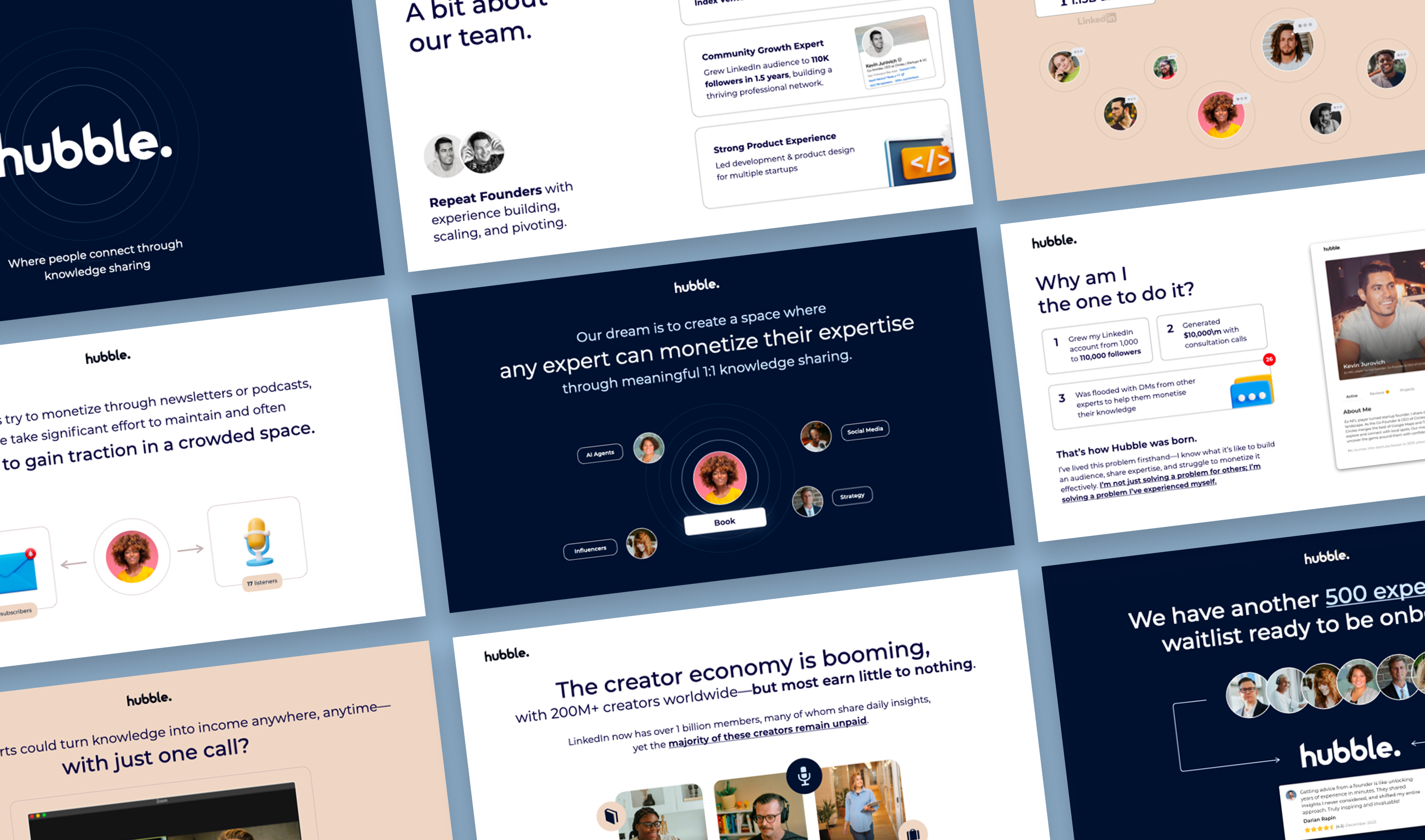
A pre-seed startup is naturally small. Investors know that. What they need to see is whether there is a believable path from the company that exists today to something much larger.
That does not mean putting an unrealistic billion-dollar projection on the final slide. The vision should grow logically from the product and market described earlier in the deck. The company might start with one narrow customer segment, one geography, or one use case, but there should be room to expand. The investor needs to understand how the product could become more valuable, how the customer base could grow, and why the opportunity is not limited to a small niche.
The best pitch decks connect a realistic starting point with an ambitious long-term outcome. That combination is important because venture investors are not only asking whether the business can survive. They are asking whether it can become large enough to justify the risk they are taking.
What Investors Are Really Trying to Understand
At pre-seed, there is always uncertainty. The product may change, the business model may evolve, and some assumptions in the deck will eventually prove to be wrong. Investors know this before they open the presentation.
What they are trying to determine is whether the fundamentals are strong enough to continue the conversation. Is the problem real and important? Is the solution easy to understand and meaningfully different? Can the company grow into a large market? Is there any evidence that the idea is moving in the right direction? And does the team look capable of learning fast enough to build the business?
That is ultimately the role of a pre-seed pitch deck. It is not to make an unfinished company look finished. It is to make the opportunity clear, credible, and interesting enough that an investor wants to take the next step.
If you are looking for the actual slide-by-slide structure, our guide How to Build a Pitch Deck for a Pre-Seed Round explains how to organize the presentation itself. And if the story is there but you need help turning it into a clear, investor-ready deck, you can also explore the pitch deck work and case studies on 100PitchDecks.
If you want to understand what your deck is missing before investors see it, book a free intro call with 100PitchDecks.
We’ll help you see where the story, structure, and positioning can be sharpened.
Artem Pochepetsky is the founder of 100PitchDecks. He has worked on 400+ pitch decks across pre-seed through Series B, with founders across 30+ countries raising a combined $250M+.